
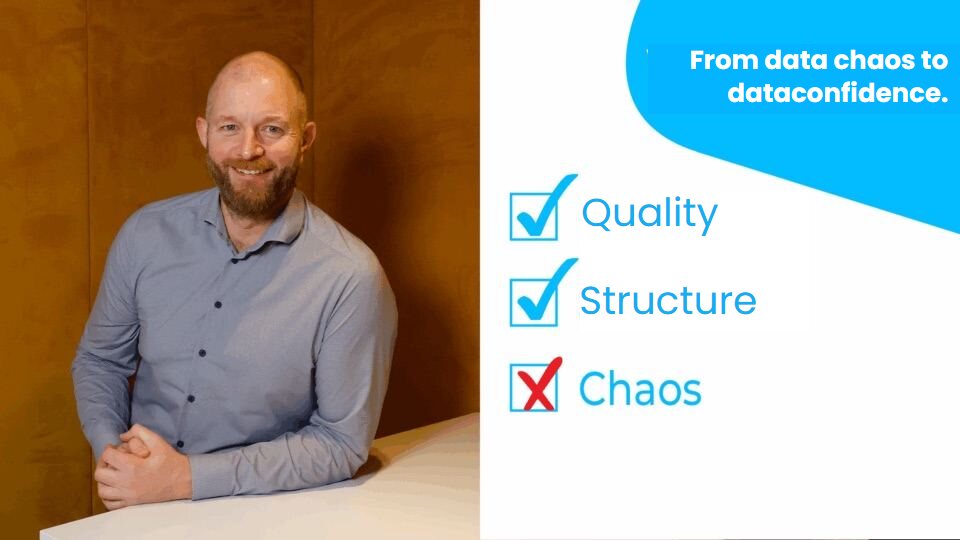
From data chaos to dataconfidence
Why data leadership is about trust, and dashboards come second


Every organisation wants to be data-driven. Money goes into dashboards, reports and KPIs, because to measure is to know, right?
But honestly: data-driven working doesn't exist.
You work people-driven or process-driven, and data is a consequence of that.
Yet "data-driven working" remains a popular slogan. It sounds modern, smart, controllable. But a real grip on data isn't about numbers. It's about trust.
Or more precisely, about dataconfidence.
Because if the data behind all those numbers can't be trusted, then knowing is mostly thinking you know.
The quiet chaos behind the numbers
Beneath every beautiful dashboard there's often a messy reality. Sources contradict each other, numbers differ per department and nobody knows which version is right.
It may sound familiar: "Power BI says something different from the source system."
That's frustrating, and it's also a symptom of something bigger: data chaos.
We store everything "just in case", while research shows that more than 90% of data in companies is no longer relevant. Old files, duplicate records, Teams folders full of versions of the same document. Storage costs nothing, yet the price is clouded judgement.
With the rise of AI, that problem only grows. Because if you speed up poor data with "smart" technology, you don't get more insight, just faster noise.
The "easy way out" reflex
We often look for the quick route, because the pressure is high.
"AI will soon solve this by itself." Or: "We'll do a training course, then we'll be data literate."
Yet real data quality asks for something else: time, collaboration and the courage to really hold processes up to the light.
It's a bit like sustainability. Everyone wants it, yet structural change takes more than a label or a project.
It's no different with data. Everyone wants to be data-driven, yet the foundation has to be solid first.
What poor data really costs
Poor data isn't a technical problem. It's a strategic risk.
It costs organisations money, time and credibility.
- Money, because wrong or duplicate data leads to missed revenue or wrong decisions.
- Time, because teams endlessly check, correct and search.
- Trust, because nobody knows what's right any more and decision-making stalls.
From perfect to adequate data
Many organisations strive for perfect data. But what actually is perfect data?
If you don't know what you're looking for, you don't know when you're satisfied either. And that makes managing hard.
One thing is certain: perfect data doesn't exist. Data lives, moves and changes, and so it naturally loses some of its quality.
The real goal is adequate data: reliable enough to base decisions on.
Adequate means you know what to expect, and that expectations within the organisation are aligned.
Take a simple example: finance expects every customer to have a company registration number. Sales knows new customers often can't supply one yet, sometimes because they're still being set up, sometimes because the number isn't to hand. Only when both sides define together when that number needs to be there do you get clarity.
That's dataconfidence: well-founded trust in what you see, instead of blind faith in data.
Expectations make trust visible
Dataconfidence starts with making expectations explicit:
- What do we consider reliable data?
- When does something meet our standard?
- And what's the impact if it doesn't, in time, money or risk?
Once those agreements exist, you can also show what it costs when data isn't right, in time, money and risk.
And that turns data quality from an IT question into a leadership issue.
From chaos to calm
Data chaos feels like being busy all the time without really getting anywhere.
Teams correct errors, check reports or search for the right version of the same number.
Once data is reliable again, the dynamic changes. Teams work with confidence. Decisions are made faster. Discussions are about the content again, instead of definitions.
That's the power of adequate data. Because everyone knows what they can rely on.
And that may well be the most underrated gain: calm.
Calm makes room for innovation, sharpness and growth.
Written by Ruud Kuil
Co-founder of MAD-Quality. Helps leadership teams move from data chaos to data they dare to manage by. Want to know more about data quality? Follow Ruud on LinkedIn.